 TRANSIT
The Metro G Line—known as the Orange Line from its 2005 opening until the 2022 system rename—is the most operationally successful Bus Rapid Transit (BRT) corridor in the United States and a pivotal case study in how political and legal constraints can redirect transit technology decisions. What began as a light rail proposal in the 1980s, shaped by Proposition A deed restrictions and community opposition, became a fully grade-separated BRT corridor that now carries more passengers daily than many light rail systems. This document traces that evolution from concept through current operations.
Origins: The Light Rail Proposal
Planning for transit in the San Fernando Valley's east-west corridor began in earnest following the passage of Proposition A in 1980, which provided the local funding foundation for the region's rail expansion program. The Southern California Rapid Transit District (SCRTD) and the Los Angeles County Transportation Commission (LACTC) evaluated several corridors for light rail investment, and the former Southern Pacific railroad right-of-way running through the Valley's flatlands—from Chatsworth in the west to North Hollywood in the east—emerged as an attractive candidate.
The Ventura Freeway median was also studied. Federal and state transportation planners examined a light rail alignment in the center median of US-101 as part of the broader Valley transit planning conducted through the 1980s. However, Proposition A's provisions restricted certain transportation uses in freeway medians, and the technical challenges of at-grade light rail on an active freight railroad right-of-way added complexity to the Southern Pacific alignment as well.
By the late 1980s, with resources concentrated on the Metro B Line (Red Line) subway and the Metro A Line (Blue Line) light rail project already under construction, Valley rail investment was deferred. The 1974 Grid Service restructuring had established a functional bus network in the Valley (see the RTD Grid Service analysis), but riders continued to demand rail-quality service on the east-west corridor.
The BRT Decision: Political and Legal Context
When LACMTA returned to the Valley corridor in the 1990s, the agency faced a changed political environment. A consent decree arising from the Bus Riders Union v. LACMTA litigation (1996) required the agency to prioritize bus service improvements. The consent decree did not preclude rail construction, but it focused institutional attention on the bus network and influenced how Valley corridor investment was framed publicly.
More directly, a ballot measure restriction on the use of the Southern Pacific right-of-way limited the technology to rubber-tire vehicles. California Proposition A (1980) deed restrictions on certain corridors, combined with local planning constraints, effectively foreclosed light rail on the Valley corridor in the form originally envisioned. LACMTA planners and Board members who had advocated for light rail acknowledged that BRT on an exclusive, grade-separated guideway was the viable alternative.
The technical decision was made easier by the maturing BRT literature of the late 1990s. Curitiba, Brazil's BRT system and the Metro Rapid program's success on surface streets in Los Angeles (launched 2000) demonstrated that BRT could deliver rail-like characteristics— off-board fare payment, level boarding, signal priority, high-quality stations—at substantially lower capital cost than grade-separated light rail.
Design and Construction
The Orange Line was designed as a fully grade-separated BRT operating on a dedicated busway along the former Southern Pacific right-of-way. Key design features included:
- Fully exclusive guideway: The 14-mile initial segment (North Hollywood to Warner Center) runs entirely on a dedicated busway with no mixed traffic operations, distinguishing it from surface BRT and "BRT-lite" implementations.
- Level boarding: Station platforms are designed at bus floor height, enabling faster, more accessible boarding comparable to light rail.
- Off-board fare collection: Riders pay via TAP card at station fare validators before boarding, eliminating dwell time at fare boxes and enabling all-door boarding.
- Transit Signal Priority (TSP): Grade-level crossings are equipped with signal preemption technology, giving approaching buses green signal phases.
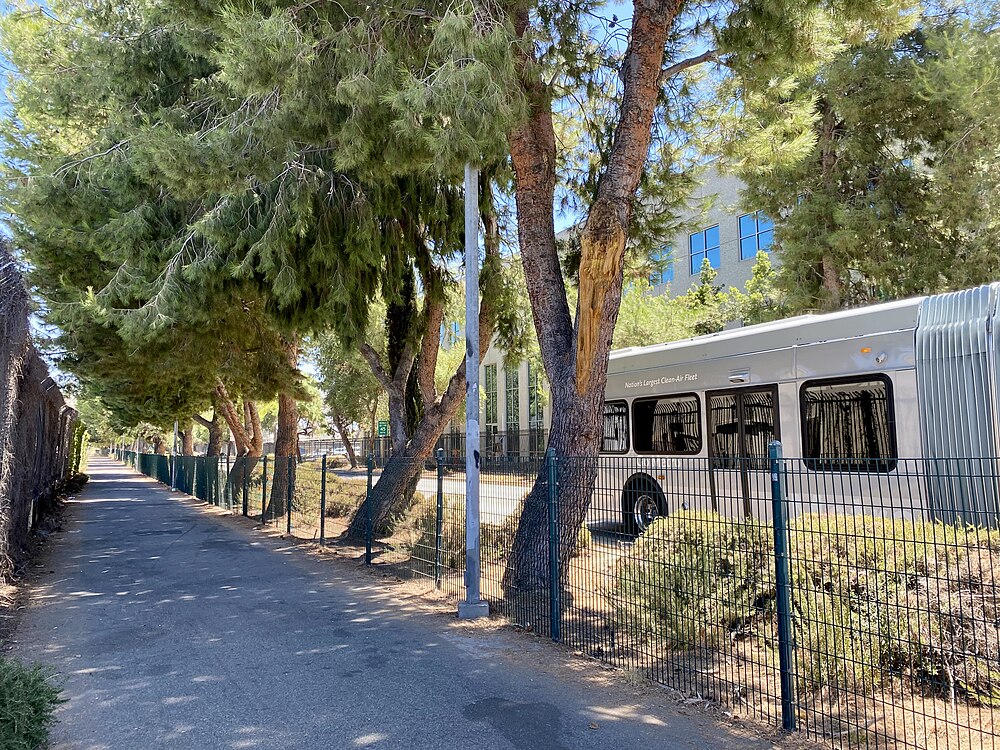
- Bicycle integration: The corridor includes a parallel bicycle path for its full length, creating a multimodal corridor that became a model for subsequent BRT projects nationally.
| Segment | Terminals | Miles | Opened | Key Stations |
|---|---|---|---|---|
| Initial segment | North Hollywood ↔ Warner Center | 14.0 | Oct. 29, 2005 | North Hollywood, Sepulveda, Reseda, De Soto, Warner Center |
| Canoga Extension | Warner Center ↔ Canoga | 1.0 | Aug. 2012 | Canoga |
| Chatsworth Extension | Canoga ↔ Chatsworth | 3.6 | Jun. 2012 | Sherman Way, Devonshire, Chatsworth |
Rolling Stock: NABI to Nova
The original Orange Line fleet consisted of 35 articulated buses manufactured by NABI (North American Bus Industries), the 60-foot NABI 60-BRT CompoSite model. These vehicles were selected for their composite body construction, which reduced vehicle weight and improved fuel efficiency compared to conventional steel-body buses. The NABI fleet entered service in 2005 and served the corridor through its initial decade of operation.
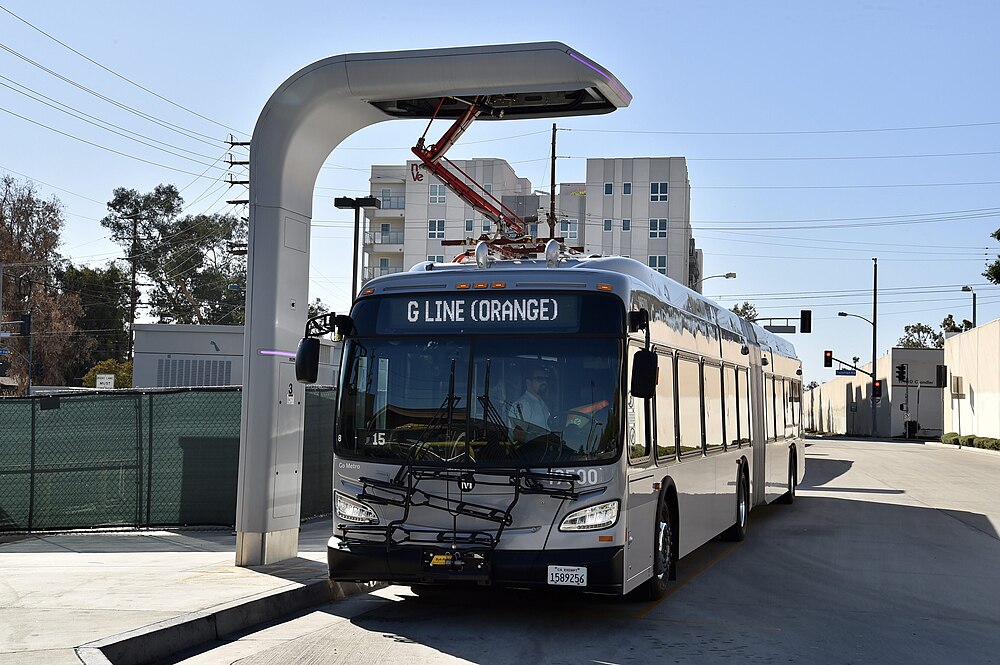
As the NABI fleet aged, LACMTA procured replacement vehicles from New Flyer Industries (Xcelsior articulated diesel-electric hybrid) beginning around 2016, supplemented by Nova Bus LFS Artic vehicles. The mixed fleet approach introduced some operational variability but maintained the 60-foot articulated format required for the corridor's passenger volumes.
The most significant rolling stock transition is now underway: LACMTA's zero-emission bus transition plan targets a fully battery-electric G Line fleet. The corridor's dedicated charging infrastructure at the Chatsworth and North Hollywood terminal facilities is being upgraded to support overnight and opportunity charging for the incoming BYD and New Flyer Xcelsior CHARGE articulated electric buses.
Operations and Ridership Performance
The G Line has consistently exceeded LACMTA's pre-opening ridership projections. Average weekday boardings on the initial North Hollywood–Warner Center segment reached 22,000 by 2007, surpassing the pre-opening projection of 17,000. The Chatsworth extensions added further ridership, and the corridor now averages approximately 26,000–30,000 daily boardings, making it one of the highest-ridership BRT corridors in North America.
Peak headways on the G Line are 4–6 minutes during the morning and evening peaks—a frequency that approaches light rail service levels and is only achievable because of the fully grade-separated, exclusive guideway. Off-peak headways are 10–12 minutes.
The 2022 Rename: Orange to G
In October 2022, LACMTA completed a systemwide line rename, replacing color-based names with letter designations to improve system legibility and eliminate confusion as new lines are added. The Orange Line became the G Line, consistent with LACMTA's sequential lettering system. The rename required updated station signage, maps, vehicle markings, and public communications across the 18.6-mile corridor.
The transition also provided an opportunity to update the corridor's wayfinding to align with the TAP card integration standards adopted systemwide, ensuring that the G Line's stations function seamlessly as part of the integrated network that connects to the B Line at North Hollywood.
Future: Electrification and System Integration
The G Line's future is shaped by two parallel considerations. First, LACMTA's commitment to a 100% zero-emission bus fleet by 2030 requires full electrification of the G Line fleet. The dedicated guideway and terminal facilities make the G Line one of the operationally simpler corridors to electrify, since buses return to terminal facilities at both ends of the line where overnight charging can take place.
Second, long-term planning discussions have revisited the question of converting the G Line guideway to light rail. The Sepulveda Pass Transit Corridor project, which would connect the Valley to LAX and the Westside, could potentially interline with a converted G Line if light rail technology is selected. For the detailed comparison of Sepulveda technology options, see the article on the Sepulveda Transit Corridor. The funding context for these decisions is described in the Transportation 101 guide.